
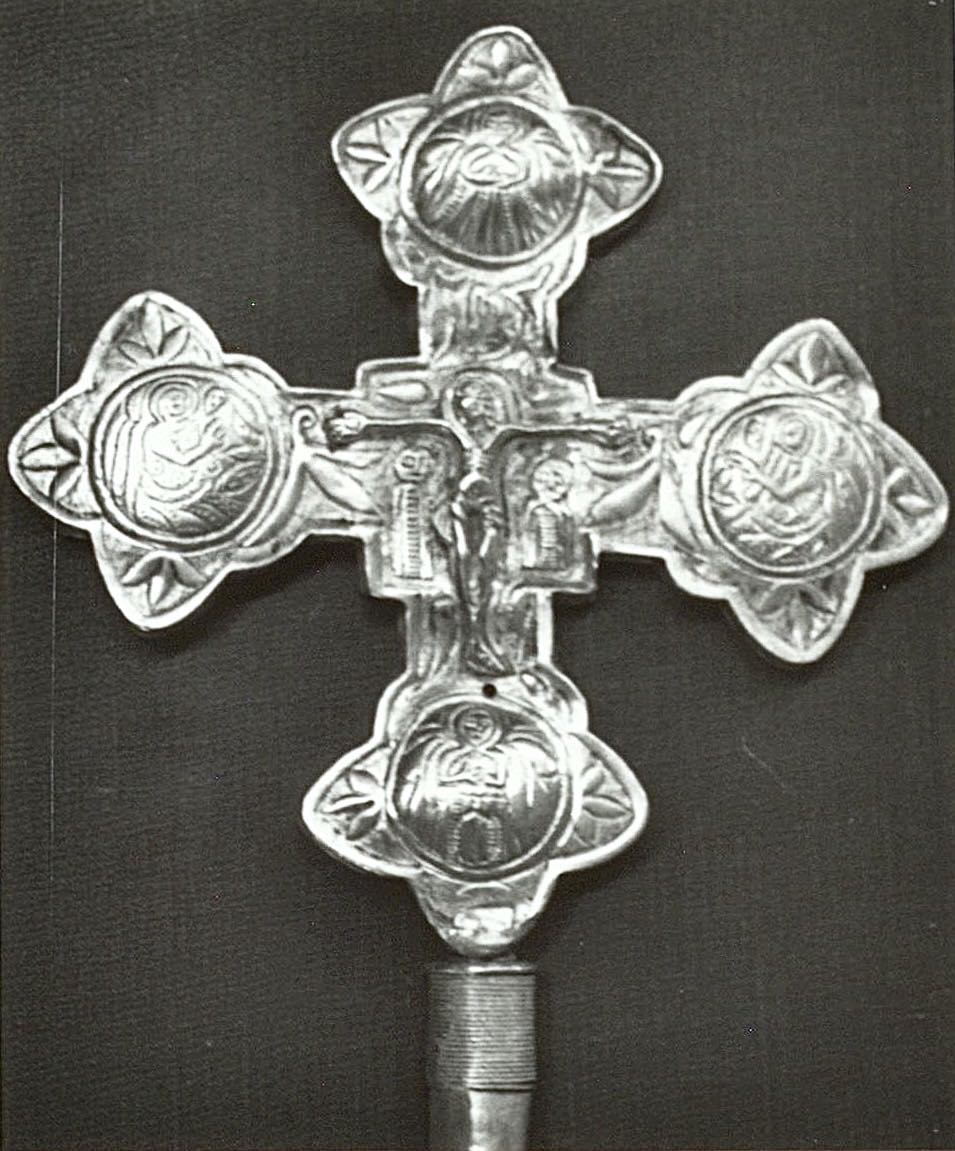
(Horizontal:) Kaččō the son of ‛Abdō and his wife Kātūn daughter of Nīsān donated (it).
(Vertical from the bottom:) to the church of Mārt(y) Šmūnī Yūh)annā, Bart)ellā, in the Christian year 1811.
 View full size
Notes
The name Šmūnī is crossed off and replaced by the name Yūh)anna inscribed below it. Whether it was an inscribing mistake committed during manufacture or the name change was due to a change of ownership is not known. In the latter case, the change of name could reflect the donor’s change of mind concerning the destination of the cross. Horizontal: The spelling of ‛Abdō with final ōlaf is unusual, unless this was confused with the Syriac article, but in this case the form should be ܥܒܕܐ (without the wāw). Vertical: An independent church of (Mār) Yūḥannā is not known in Barṭellī, but a monastery of the martyr Yūḥanōn bar Naggārē (John son of the Carpenters) was built near the town by mafriōnō Bar-Hebraeus, and was still functioning at the end of the 16th century. After its subsequent destruction, the remains of the martyrs were brought to the church of Mārt(y) Šmūnī and were buried inside a niche; Fiey 1965-1968, vol. II, p. 431-435. Thus, the silver cross was specifically donated to the martyr’s niche and this explains why the name Šmūnī was crossed off.
Context
| Date | 1811 AD |
|---|---|
| Language | Garshuni |
| Script | Serto |
| Location Detail | Syriac Orthodox Church of the Virgin Mary |
People & Roles
| Mafrionē | Bar-Hebraeus |
|---|---|
| Benefactors | Donor of the silver cross |
Religion & Practice
| Relics | Remains of the martyrs buried inside a niche |
|---|---|
| Monasteries | Monastery of the martyr Yūḥanōn bar Naggārē built near Barṭellī by mafriōnō Bar-Hebraeus |
| Churches & Shrines Named After | Church of Mārt(y) Šmūnī; church of Mār Yūḥannā |
Material & Physical
| Cross | Silver cross donated to the martyr's niche |
|---|
History & Context
| Countries & Cities (Foreign) | Barṭellī |
|---|
Personal Names
Šmūnī
Yūḥannā
Yūḥanōn bar Naggārē
Bar-Hebraeus
References
Harrak 2010, p.195-196