About the Place
Governorate
Governorate of Nineveh
This modern administrative district, named after the famous Assyrian capital Nineveh, covers Mosul, the medieval and modern counterpart of ancient Nineveh; the Assyrian triangle formed by the Tigris and the Lower Zāb to the east; and the region of Sinjār as far as the Iraqi-Syrian border to the west. The first Christian community lived near the ruins of ancient Nineveh on the east side of the Tigris, where Syriac sources place a “diocese of Nineveh”. By the 6th century the diocese had expanded to the west side of the Tigris, before the city of Mosul was founded, probably with the arrival of the Arabs in the early 7th century. Between the Tigris and the Lower Zāb several Christian communities, often very large and well organised, have lived from the earliest centuries of our era to this day. Most are located near archaeological mounds of distant antiquity, underlining the indigenous nature of the local inhabitants. Barṭellī (AB), Qaraqōš or Bēt-Kudēdā (AD), Karamlēs (AC), Alqōš (AO) and others are modern towns, but their names frequently occur in ancient manuscripts and inscriptions. Major monasteries were also built here, some of which, such as the Monastery of Mār Behnam (AE.01, AE.02) and the Monastery of Mār Mattā (AF), still stand and function today.
In the Abbasid period Mosul belonged to the province of Jazīra, “the Island”, so called because it was surrounded by the Tigris and the Euphrates. It was heavily populated by Syriac-speaking Christians, about whom we know a little from Syriac chronicles and other sources. In the 13th century Mosul enjoyed a golden age under Atabeg rule. Christian buildings of that period, such as the Monastery of Mār Behnam (AE.01 and AE.02), reflect the outstanding skill of the local people in art, mainly sculpture, and in architecture. In the 14th century the Christian communities of Mosul grew. As a result of the fall of Baghdad to the Mongol warrior Tamerlane, Christianity retreated from its birthplace in Babylonia, from the Mesopotamian centre (Takrit) and from the rest of the region to the outskirts of Mosul. Finding the mountainous north more secure than the southern plain, the refugees joined the well-established Christian communities already there.
In the Ottoman era, which began in 1516, the local Christians lived unmolested until the armies of the Persian Nādir Shah Tahmasp invaded the region in 1743. In this fertile and densely populated land, centuries-old churches were destroyed along with their furniture and manuscripts. The ruling Sultan Mehmud I rewarded the populations that had resisted the invader by allowing the Christians to rebuild their churches. As the commemorative inscriptions show, the Syriac term ḥaddet “renovate” often means “build anew”. Since Christians in Islamic lands were legally prohibited from building new churches, the word “rebuild” masked a different reality: some churches were so damaged that they had to be torn down completely and built afresh. The invasion of Tahmasp proved truly destructive. Most of the Syriac inscriptions in Mosul and its suburbs date from shortly afterwards, sometimes just one year later. Slabs bearing older inscriptions were reused in building and rebuilding, and some were ground into lime for mortar. In 1815 an epidemic struck the region of Mosul, killing thousands of people and opening a new chapter in the region’s history.
Syriac inscriptions abound in the governorate of Nineveh and make up the bulk of the present corpus. They are found in churches, monasteries and cemeteries, and above the doors of private houses. Several, especially after the invasion of 1743, are in Garshuni (Arabic written in Syriac script); Arabic written in this way is colloquial and heavily influenced by Syriac. Inscriptions in Arabic script appear in the late 19th century, though they are relatively few; we include those important for a better understanding of the Syriac inscriptions found with them. We begin with the city of Mosul, rich in churches, and move on to the other Christian settlements in its vicinity.
Locality
Mosul
Before the Arab era, the site of Mosul was occupied by a modest fortress on the west bank of the Tigris, facing the ruins of the Assyrian capital Nineveh. Syriac sources call it ḥesnā ‛ebrāyā, “the Hebrew Fortress” or, since that translation is debatable, “Across-the-Fortress” (for a discussion see Fiey 1959, p. 11 note 2). Near this spot a “Ninevite” monk named Īšō‛yahb bar Qusrī built a monastery at the end of the 6th century. His name survives in the form Ēša‛iā, lit. “Isaiah” (a popular confusion of *Īšō‛yaw > Ēša‛iā), though the modern church that bears it is of a later period. Old Mosul has thirteen churches belonging to the various Christian communities, some of them grouped together. In the quarter called Qal‛a (“fortress”) there are four: two, including an old one, belonging to the Catholic Syriacs, one to the Orthodox Syriacs and one to the Orthodox Armenians. The Mayyāsa quarter has three main churches: two, including chapels, belonging to the Chaldeans, and one to the Orthodox Syriacs. The Kazraj quarter, also called al-Sā‛a (Arabic for “clock”, after the clock tower of the Dominican convent), contains two Chaldean churches, two Orthodox Syriac churches and one Catholic Syriac church, as well as the church of the Dominican Fathers. The Christians of Mosul lived around these clusters of churches for centuries, though most have now moved to the outskirts of the city, where the ruins of ancient Nineveh can still be seen.
All these churches have Syriac inscriptions inside and outside, and in the cemeteries normally found in their courtyards. Some of the churches have recently collapsed because of groundwater. Some inscriptions have disappeared for ever, others need excavation, and others still stand. Three monasteries around Mosul offer a few inscriptions. These buildings are either abandoned or recently renovated, and in both cases other inscriptions may have been destroyed. The Mosul Museum also holds a few inscriptions gathered from various places.
Site
The Mosul Cultural Museum
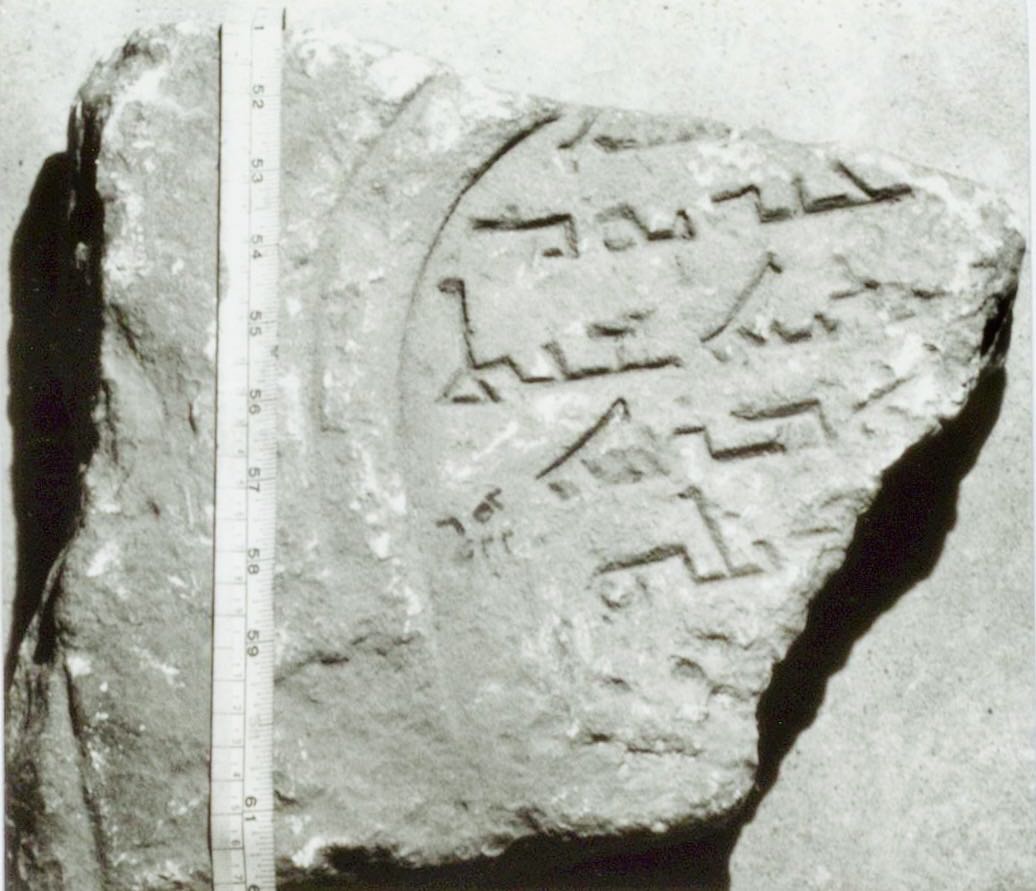
The Museum, located in Mosul near the al-Dawwāsā quarter, has an internationally renowned collection of very important archaeological artefacts from prehistoric to medieval times. It houses a few Syriac inscriptions, one of which comes from Balad (Aski-Mosul) and is edited in this Corpus under that locality (AI). I am grateful to the late Mr. Manhal Jabr, director of the Mosul Museum and a very gentle man, for allowing me to photograph the inscriptions.