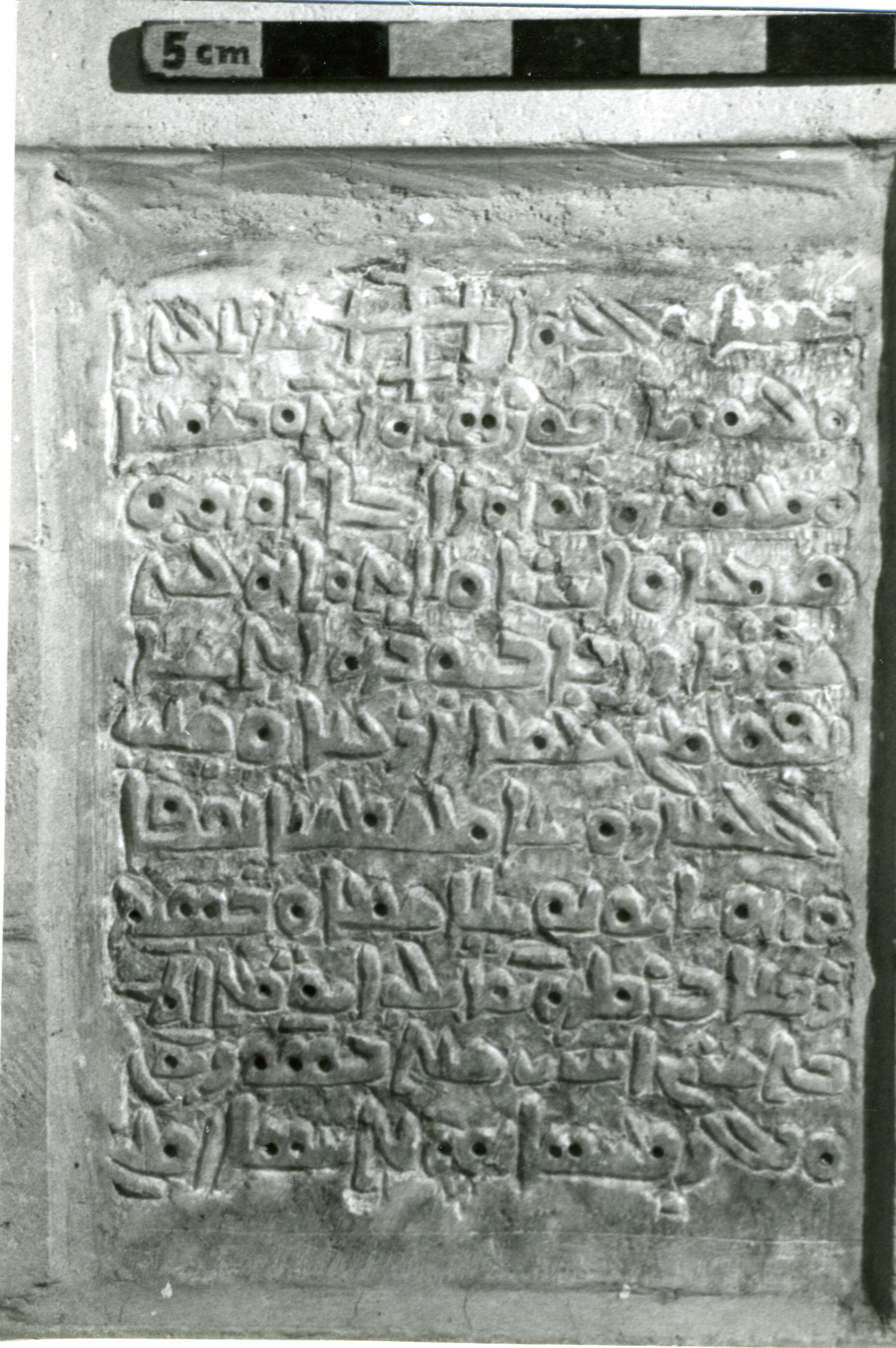
Notes
Line 5: The stereotyped formula breaks off abruptly, suggesting either that the stonecutter missed one or more lines or that frequent use in Qaraqōš had made the formula almost meaningless to the people.
About the Place
Governorate
Governorate of Nineveh
This modern administrative district, named after the famous Assyrian capital Nineveh, covers Mosul, the medieval and modern counterpart of ancient Nineveh; the Assyrian triangle formed by the Tigris and the Lower Zāb to the east; and the region of Sinjār as far as the Iraqi-Syrian border to the west. The first Christian community lived near the ruins of ancient Nineveh on the east side of the Tigris, where Syriac sources place a “diocese of Nineveh”. By the 6th century the diocese had expanded to the west side of the Tigris, before the city of Mosul was founded, probably with the arrival of the Arabs in the early 7th century. Between the Tigris and the Lower Zāb several Christian communities, often very large and well organised, have lived from the earliest centuries of our era to this day. Most are located near archaeological mounds of distant antiquity, underlining the indigenous nature of the local inhabitants. Barṭellī (AB), Qaraqōš or Bēt-Kudēdā (AD), Karamlēs (AC), Alqōš (AO) and others are modern towns, but their names frequently occur in ancient manuscripts and inscriptions. Major monasteries were also built here, some of which, such as the Monastery of Mār Behnam (AE.01, AE.02) and the Monastery of Mār Mattā (AF), still stand and function today.
In the Abbasid period Mosul belonged to the province of Jazīra, “the Island”, so called because it was surrounded by the Tigris and the Euphrates. It was heavily populated by Syriac-speaking Christians, about whom we know a little from Syriac chronicles and other sources. In the 13th century Mosul enjoyed a golden age under Atabeg rule. Christian buildings of that period, such as the Monastery of Mār Behnam (AE.01 and AE.02), reflect the outstanding skill of the local people in art, mainly sculpture, and in architecture. In the 14th century the Christian communities of Mosul grew. As a result of the fall of Baghdad to the Mongol warrior Tamerlane, Christianity retreated from its birthplace in Babylonia, from the Mesopotamian centre (Takrit) and from the rest of the region to the outskirts of Mosul. Finding the mountainous north more secure than the southern plain, the refugees joined the well-established Christian communities already there.
In the Ottoman era, which began in 1516, the local Christians lived unmolested until the armies of the Persian Nādir Shah Tahmasp invaded the region in 1743. In this fertile and densely populated land, centuries-old churches were destroyed along with their furniture and manuscripts. The ruling Sultan Mehmud I rewarded the populations that had resisted the invader by allowing the Christians to rebuild their churches. As the commemorative inscriptions show, the Syriac term ḥaddet “renovate” often means “build anew”. Since Christians in Islamic lands were legally prohibited from building new churches, the word “rebuild” masked a different reality: some churches were so damaged that they had to be torn down completely and built afresh. The invasion of Tahmasp proved truly destructive. Most of the Syriac inscriptions in Mosul and its suburbs date from shortly afterwards, sometimes just one year later. Slabs bearing older inscriptions were reused in building and rebuilding, and some were ground into lime for mortar. In 1815 an epidemic struck the region of Mosul, killing thousands of people and opening a new chapter in the region’s history.
Syriac inscriptions abound in the governorate of Nineveh and make up the bulk of the present corpus. They are found in churches, monasteries and cemeteries, and above the doors of private houses. Several, especially after the invasion of 1743, are in Garshuni (Arabic written in Syriac script); Arabic written in this way is colloquial and heavily influenced by Syriac. Inscriptions in Arabic script appear in the late 19th century, though they are relatively few; we include those important for a better understanding of the Syriac inscriptions found with them. We begin with the city of Mosul, rich in churches, and move on to the other Christian settlements in its vicinity.
Locality
Qaraqōš
Qaraqōš (Turkish for ‘the black bird’), Bēt-Kudēdā, Bukdēdā or Baġdēdā in Syriac (among other conflicting spellings), and al-Ḥamdāniyya are all names of one town, inhabited solely by an Aramaic-speaking population proud of its language, Christian religion and cultural heritage. It lies to the east of Mosul, on the same road as two other Christian towns, Barṭellī (AB) and Karamlēs (AC). Water for these towns has always been abundant, since the perennial river Kāzir is 13 km to the east and the Great Zāb 30 km to the south. In the late 1950s the town had some seven thousand inhabitants, but today’s number is less certain; many local families moved to Baghdad and now to the West. Most of the inhabitants are Roman Catholics of the Syriac Rite, but several Syriac Orthodox families have their own churches. In antiquity Qaraqōš was “Nestorian”; it shifted to “Monophysitism” around the beginning of the 7th century under the influence of the Monastery of Mār Mattā (AG.01), and then to Catholicism around the middle of the 18th century. Several inscriptions commemorate the deeds of a number of mafriōnē, West-Syriac leaders in Mesopotamia, who made the town their administrative see.
We know much about Qaraqōš from a variety of sources, especially the colophons of manuscripts copied there. In modern times several books in Arabic have traced the history of this important Syriac town, the most complete being Sōnī 1998, whose author consulted hundreds of local manuscripts and inscriptions that shed much light on the town’s history over the centuries. Qaraqōš has seen times of glory and times of true hardship. It suffered severely during the invasion of the region by the Persian Nādir Shah in 1743, and several literary accounts of this event by eyewitnesses from the town itself survive; see AD.03.4 below. The situation improved, however, when the destroyed churches were rebuilt even more magnificently; the town is dotted with churches and shrines, some of them truly monumental. Most have Syriac inscriptions inside, but inscriptions are also found in cemeteries and mausoleums. Although there are several studies of these churches in French and Arabic, the inscriptions have never been edited systematically: Pognon (Pognon 1907) discusses only some of them, and Sōnī’s book offers only translations.
Several trips to Qaraqōš were needed to photograph and study the inscriptional material in situ. On every trip I enjoyed the hospitality, friendship and constant assistance of Fathers Louis Qaṣṣāb, Šarbel ‛Īsū and Noël Karrōmī, and I am very grateful to them for opening the inscriptional wealth of their churches to me.
Site
The Syriac Orthodox Church of Sergius and Bacchus
This Syriac Orthodox church stands on a low mount on the west side of Qaraqōš. The Syriac Orthodox nation has particularly venerated Sts Sergius and Bacchus since the 6th century, and the church could date from any time after that. As Dr. Brock has pointed out to me, the earliest mentions of the church occur in manuscripts dated Sel. 1870 (AD 1558), Sel. September 1880 (AD 1569) and Sel. 1885 (AD 1573), in the (lost) Vorlagen of Mingana syr. 14, 422 and 554 respectively. In 1743 the church was badly damaged by the invading armies of Nādir Shah the Persian. As soon as the war ended, the people of Qaraqōš, at the instigation of Bishop Karas, Abbot of the monastery of Mār Behnam, cleared the ruins and rebuilt the church on its existing foundations, with inscriptions running around the entire wall of the sanctuary. These are true annals in stone, very reminiscent of the Assyrian annals inscribed on the same local farš-stone. They describe in great detail the Persian invasion and its destructive consequences, the energy of the Christians in rebuilding their shrines, and the pivotal role of one man in rebuilding this region of the Assyrian heartland. Building work continued up to 1980, when renovations altered the ancient character of the church, particularly on the outside. When the photographs were taken, the two gates into the church had been removed and their stone fragments discarded, quite carelessly, in a corner of the courtyard.